Booklet Printing
Multi-page booklets built for catalogs, guides, and event programs.
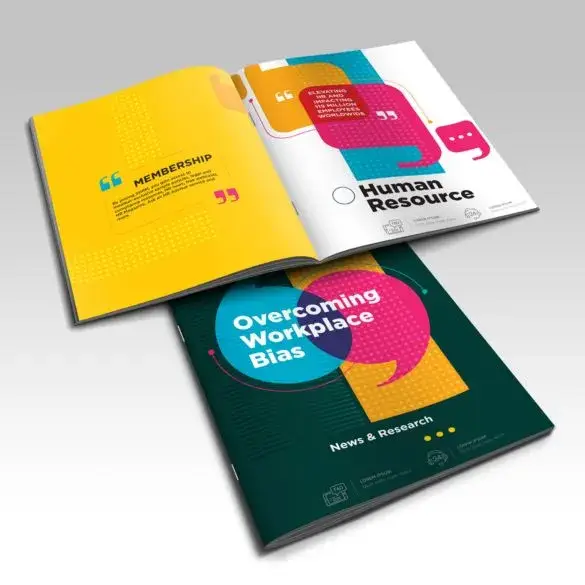
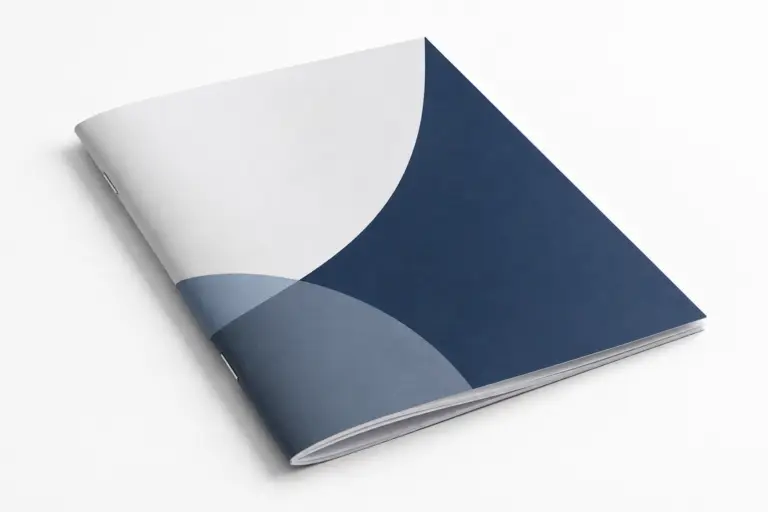
Saddle stitch, spiral, or perfect, matched to your page count.
Finished the way your content looks best.
Someone flips through before it ships, not just a machine count.
Booklets have a lot of options. We’ll walk you through it.
A proof before anything prints, every single order.
A look at saddle stitch, spiral, and perfect binding side by side.
← Swipe to see more →
| Binding Type | Best Page Range | Cover | Common Use | Availability |
|---|---|---|---|---|
| Saddle Stitch | 32 pages or less | Optional, often not needed at 80lb text or heavier | Catalogs, event programs, guides | Standard |
| Spiral | Better for bigger booklets, too thick for saddle stitch | Clear front, black back standard, cardstock available | Presentations, training materials, reports | Standard |
| Perfect Binding | Larger page counts | Included, standard for this binding type | Full catalogs, larger publications | Special request, 50 book minimum |
| For saddle stitch booklets, page counts must be in multiples of 4 (16, 20, 24, 28, etc.). Spiral and perfect binding aren't restricted the same way. | ||||
Booklets have more decisions built into them than most print products, binding, paper weight, cover, and page count all work together. Here’s how we help you land on the right combination.
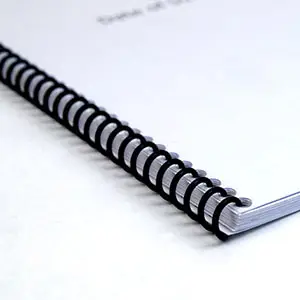
Saddle stitch is our most common binding and works well up to 32 pages, though it looks its best kept toward 20 or under. Past that, the fold starts to bulge and the booklet doesn’t lay as flat. Spiral binding is the better fit for bigger booklets, it handles higher page counts cleanly and is a common choice for presentations, training materials, and reports where the book needs to lay flat or fold all the way back.
Spiral binding always includes a cover, a clear front so your first page shows through and a black plastic back as our standard. Cardstock covers are available too if you want a more solid, opaque look front and back.
For saddle stitch, cover or no cover comes down to your paper weight. Printing on 80lb text or heavier often means you don’t need a separate cover at all, the paper itself feels substantial and reads as a finished, professional booklet. Below 80lb, a cover is usually worth adding depending on how the booklet will be used and handled. We’re happy to talk through which makes sense for your project.
Perfect binding, the flat glued spine you’d see on a paperback, is available for larger books as a special request with a 50-book minimum. It’s the right call for full catalogs or larger publications, and it’s worth planning ahead for since it comes with a longer lead time than our standard bindings.
One technical detail that matters for saddle stitch specifically: page counts have to come in multiples of 4, 16, 20, 24, and so on, since each sheet folds to create 4 pages. Spiral and perfect binding don’t carry that same restriction. Worth knowing before you finalize your content if saddle stitch is your binding of choice.
Tell us your page count, binding preference, and any details you have. We'll reach out if we have questions.
Review your quote, approve it, and pay your deposit to get started.
We'll send a proof before anything prints, so we're both on the same page.
Takes just a few minutes, and we’ll follow up fast.
Please include any special instructions for your project. If you need additional services, please contact us at (205) 963-7748 or email us at ldi@ldiproprinting.com.
Booklet files work differently than a single-page print job, since pages need to be set up in the correct order and account for how the booklet gets bound and folded.
For saddle stitch booklets, page count has to be a multiple of 4, 16, 20, 24, and so on, since that’s how the sheets fold to form pages. Spiral and perfect bound booklets aren’t restricted to multiples of 4 the same way.
Send us single pages in order, page 1 as your front cover, page 2 as the inside front cover, and so on straight through. Don’t send spreads or reader-facing layouts, those get set up on our end during production.
Crossovers, images or design elements that flow from one page to the next, work best when kept to the center spread, the two middle pages that sit directly across from each other once the booklet is bound. Crossovers placed anywhere else in the booklet won’t line up correctly, since that’s the only spot in a saddle stitch or spiral bound book where two pages actually meet edge to edge.
We recommend 300 dpi resolution and CMYK color mode for accurate printing. Include a 1/8″ bleed. Vector files like PDF work best for text and logos. If you designed in Canva, we can work with that too, just share the link with us instead of downloading it yourself.
Don’t have a print-ready file? That’s fine. Upload what you have, and we’ll build it into something that prints clean and reads in the right order. If you have any questions along the way, call, text, or email us.
Turnaround for saddle stitch and spiral booklets depends on quantity, page count, and how complex the setup and design work is. Some projects move quickly, others take more time to get right, especially if there’s design work involved.
Perfect binding is a special order item with a longer, more variable lead time.
The best way to get a real timeline is to reach out with your file, or as much detail as you have. Once we see what we’re working with, we can give you an accurate turnaround instead of a guess.
Call us at 205-963-7748 or use the form above to get started.
Booklets have more decisions packed into them than almost anything else we print, binding, paper weight, cover, page count. We’d rather walk you through those choices upfront than have you order the wrong combination and start over.
That’s why we didn’t build a form with fifteen dropdown menus trying to cover every possible combination. Tell us what you’re picturing, and we’ll help you land on the right specs instead of guessing your way through a checkout page that doesn’t actually fit your project.
Once we’re building your booklet, that same attention carries through. A booklet gets handled, page by page, cover to cover, in a way a flyer or a business card never does. We check page order and crossovers before anything prints, because a booklet that’s wrong doesn’t just look bad, it reads wrong, and nobody catches that until it’s already in someone’s hands.
Twenty years of printing in Birmingham means we’ve seen booklets go out clean and booklets that came back because a step got missed somewhere else. We’d rather ask an extra question upfront than be the second version of that story.
Saddle stitch uses two staples along a folded spine and works best for shorter booklets. Spiral uses a coiled wire or plastic binding that lets pages fold all the way back. Perfect binding is a flat, glued spine like a paperback, used for larger books.
This applies specifically to saddle stitch booklets, since each sheet of paper folds to create 4 pages. Spiral and perfect bound booklets aren't restricted to multiples of 4 the same way.
It depends on your paper weight and binding. Saddle stitch on 80lb text or heavier often doesn't need a separate cover. Spiral binding always includes a cover, standard clear front and black back.
It depends on your project and binding. Heavier stock, 80lb or higher, gives you a substantial feel and can often skip a separate cover. We're happy to help you choose based on how the booklet will be used.
Yes, but crossovers work best on the center spread, the two middle pages that meet directly when the booklet is bound. Crossovers placed elsewhere won't line up correctly.
Yes, as a special request item with a 50-book minimum. It's a good fit for full catalogs or larger publications, and it comes with a longer lead time than our standard bindings.
Use the form above to tell us about your project, or call us directly if you'd rather talk through your options first.
Home » Booklet Printing Birmingham
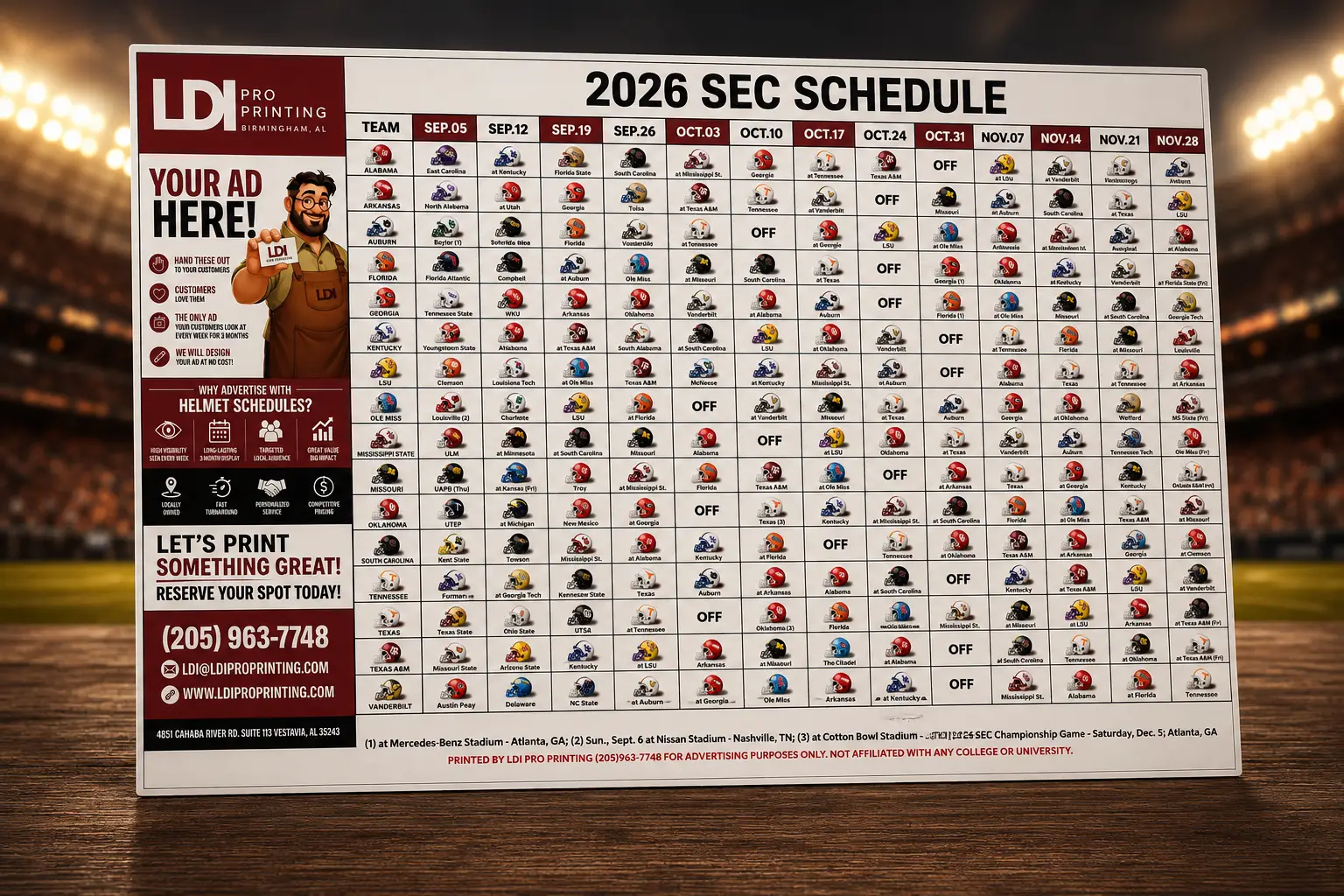
Your ad goes on SEC Football Schedules, ready to hand out to your own customers, starting at $33.38.